
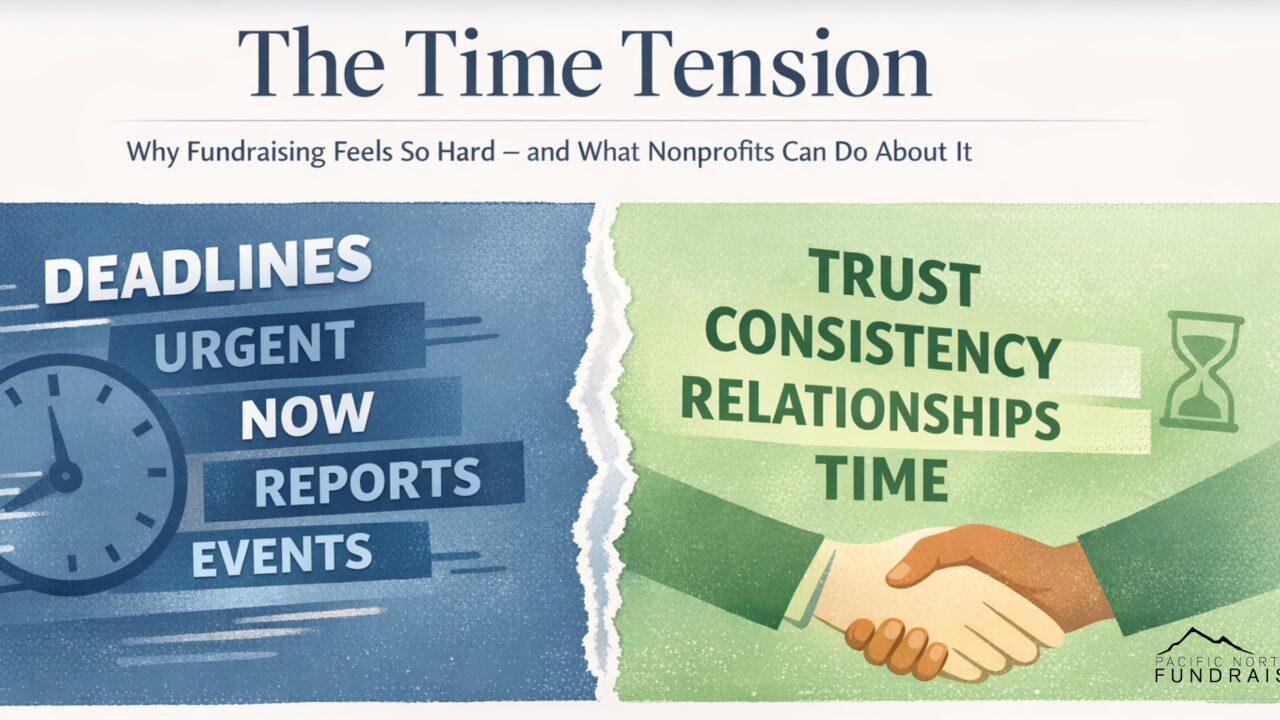
I left a recent gathering of the Pacific Northwest Fundraising (PNWF) Advisory Board with a few pages of notes and one insight I can’t stop thinking about:
Time keeps coming up.
Not time management tips. Not “work faster.” Not “do more with less.”
I mean something deeper — a structural tension that sits at the center of nonprofit leadership and fundraising.
Nonprofits are almost always managing deadlines:
- grant windows
- event timelines
- reporting requirements
- board cycles
- program deliverables
- community needs that can’t wait
And yet donor development is, by definition, a process that unfolds over time.
That disconnect creates a constant friction:
The urgency of “right now” collides with the long-game nature of relationship-based fundraising.
If you’ve ever felt like you’re failing at fundraising… you’re not. You’re experiencing a system problem.
Let’s name it clearly.
The “Deadline Trap”
Nonprofit leaders are trained (and rewarded) to respond to urgency.
Urgency looks like:
- a grant due Friday
- An event next month
- a crisis in the community
- a budget shortfall
- a board member asking for numbers
Urgency is loud. It demands attention.
But donor development is quiet. It’s built through:
- consistency
- follow-up
- gratitude
- trust
- repetition
- relationship
And relationships don’t operate on deadlines. They operate on credibility and continuity.
That’s why fundraising often feels like pushing a boulder uphill — because donor development is constantly getting bumped down the priority list by the next “fire.”
Donor Development Isn’t a Project. It’s a Practice.
One of the biggest misunderstandings in the sector is treating fundraising like a project you can complete.
But donor development is not a task you finish. It’s a practice you sustain.
It’s like health.
You don’t “go to the gym once” and get fit. You build habits, routines, and systems that keep you consistent.
In fundraising, those habits are things like:
- sending timely acknowledgements
- sharing impact updates
- building an annual stewardship rhythm
- tracking relationships in a database
- segmenting communication
- planning campaigns in advance
- meeting with donors even when you’re not asking
This is the work that creates donor confidence.
And donor confidence is what creates donor retention.
The Real Cost Isn’t Time. It’s Fragmentation.
When leaders feel like they “don’t have time for fundraising,” the issue usually isn’t the calendar.
The issue is fragmentation.
A leader might have 40 hours in a week, but those hours are chopped into:
- 15 minutes here
- 30 minutes there
- meetings stacked back-to-back
- tasks constantly interrupted
- emotional load is always running in the background
Fundraising requires a different kind of time.
It requires:
- uninterrupted thought
- planning
- preparation
- follow-through
- consistency
And consistency is the first thing to disappear when a nonprofit is operating in survival mode.
Why This Matters: Fundraising is Infrastructure
Here’s the hard truth:
When fundraising becomes reactive, the organization becomes fragile.
Because fragile fundraising depends on:
- one big event
- one grant
- one major donor
- One exhausted staff member is holding it together
That’s not sustainable.
Fundraising is not a cost center. It’s not overhead. It’s not “extra.”
Fundraising is infrastructure.
It’s the system that creates stability, so the mission can expand without burning people out.
What Nonprofits Can Do: 5 Practical Shifts
This is where the hope lives. Because there are ways to break the time tension.
1) Stop treating donor development like an optional task
If donor development is optional, it will always lose to urgency.
Instead, treat it like:
- financial reconciliation
- payroll
- program compliance
Not glamorous — but non-negotiable.
2) Build a repeatable rhythm (not random bursts)
Instead of reinventing fundraising every season, build a calendar.
A simple rhythm might look like:
- monthly donor impact update
- quarterly campaign moment
- year-end giving push
- one recurring emphasis month
- donor thank-you week
Donors don’t need perfection. They need consistency.
3) Protect “relationship time.”
Fundraising isn’t built in the margins.
If you’re a leader, protect:
- 2 hours/week for donor follow-up
- 1 hour/week for donor strategy
- 1 block/month for donor meetings
The work expands to fill the space you give it. Give it space.
4) Get serious about systems (“No database, no donor development”)
This is one of our core beliefs at PNWF:
No database, no donor development.
If donor information lives in:
- someone’s inbox
- a spreadsheet
- a volunteer’s memory
You’re not building a development program — you’re improvising.
A donor database is not optional. It’s the foundation.
5) Increase capacity (because burnout is not a strategy)
Most nonprofits aren’t failing because they lack passion.
They’re failing because the development workload is unrealistic.
Too many organizations hire a single “Development Director” and expect them to do:
- donor development
- major gifts
- events
- newsletters
- social media
- grant writing
- design
- communications
- sponsorships
That’s not one job. That’s a department.
If we want sustainable fundraising, we have to stop building systems that rely on exhaustion.
The Takeaway
If fundraising feels hard, it’s not because you’re doing it wrong.
It’s hard because you’re trying to do long-game relationship work inside a short-game urgency system.
But there’s a path forward.
It starts with:
- naming the time tension
- building a stewardship rhythm
- creating systems
- increasing capacity
Fundraising is a team sport. And sustainable development is built over time.
A Question for Nonprofit Leaders
What’s the biggest “time tension” you’re navigating right now?
Is it:
- board pressure
- grant deadlines
- program delivery
- staffing shortages
- events
- constant emergencies
I’d love to hear what you’re experiencing — and what would genuinely give you capacity back.
If you have questions, reach us through 📧 outreach@pacificnorthwestfundraising.us
🗓️ Schedule time: https://meetings.hubspot.com/eddie94