
Across the nonprofit sector, there’s a growing sense that something fundamental has shifted.
Budgets feel tighter. Grant decisions feel less predictable. Government funding feels more fragile. Boards are anxious. Staff are stretched thin.
Many leaders are quietly asking the same question:
Why does what used to work no longer feel reliable?
The answer is uncomfortable — but clarifying:
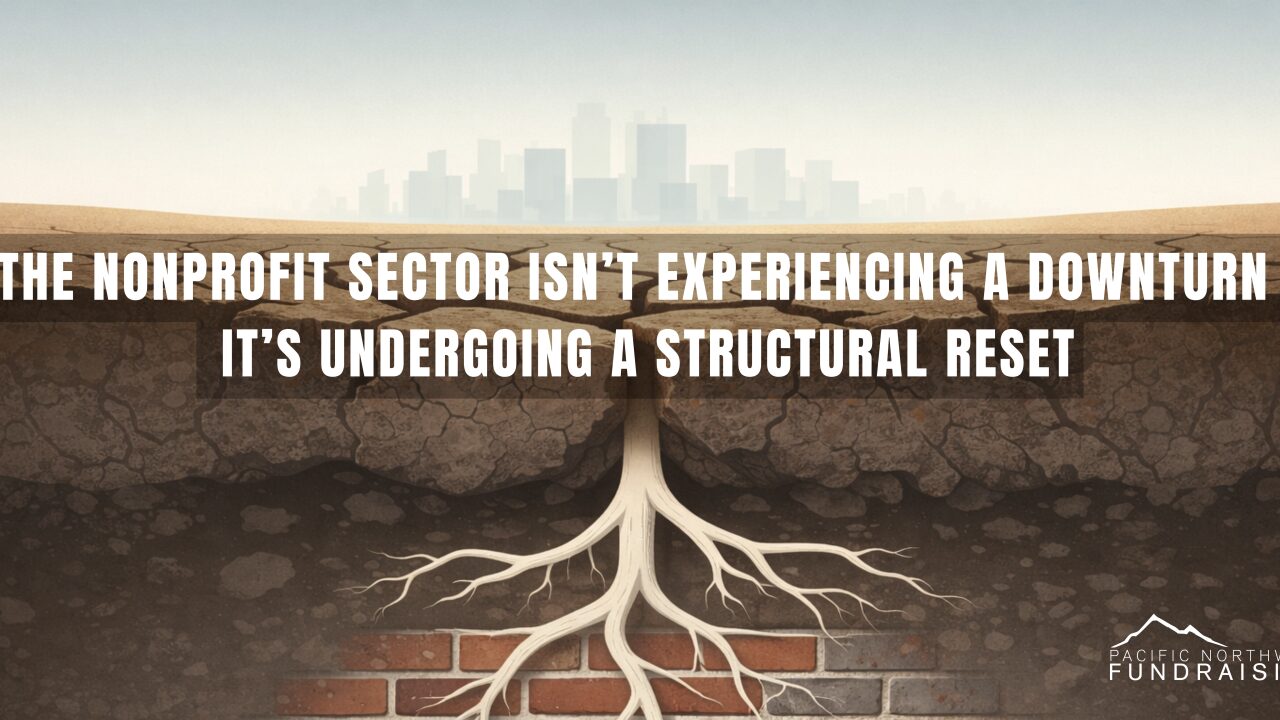
This isn’t a temporary downturn. It’s a structural reset.
Stability Is No Longer Guaranteed
Recent reports across the sector confirm what many nonprofit leaders are already experiencing firsthand: government funding is becoming less reliable, competition for foundation dollars is increasing, and demand for services continues to rise.
The result is a widening gap between need and predictability.
That gap is forcing organizations to make faster, harder decisions — often without the infrastructure to support them.
This Isn’t a Fundraising Problem
When revenue tightens, the instinct is often to push harder:
- Another campaign
- More grant applications
- Another event
- More urgency
But for many organizations, the challenge isn’t effort.
It’s infrastructure.
Grants, events, and sponsorships are inherently volatile. They can be important parts of a funding mix — but in today’s environment, they are no longer sufficient on their own.
What’s being exposed right now is the absence of something more durable.
Development Systems Are the Difference
Organizations weathering this moment most effectively tend to share a few things in common:
- Clean, usable donor data
- Consistent stewardship
- Strong recurring giving programs
- Intentional relationship-building
- Boards aligned around realistic timelines
In other words, they’ve invested in development systems, not just fundraising activity.
These systems don’t create instant spikes. They create stability — and stability is now a survival issue.
Why Individual Donors Matter More Than Ever
As institutional funding becomes less predictable, individual donors — especially recurring donors — are increasingly the backbone of resilient organizations.
Not because they’re easier. But because they’re relational.
Recurring donors smooth cash flow. Retention reduces pressure. Major gifts grow out of trust built over time.
This kind of philanthropy doesn’t happen accidentally. It happens because organizations choose to build the systems and culture that support it.
The Timing Reality Boards Must Understand
Development follows a predictable arc:
- Early months focus on systems, engagement, and stewardship
- Results compound later — not immediately
Many boards still evaluate development work using campaign-style metrics. In this environment, that mismatch is no longer just frustrating — it’s risky.
Organizations that abandon development infrastructure because it doesn’t show immediate ROI often find themselves more vulnerable, not more agile.
Adaptation, Not Optimization
The organizations that will emerge strongest from this moment aren’t the ones that optimize yesterday’s strategies.
They’re the ones that adapt.
They’re building donor engines instead of chasing one-time wins. They’re prioritizing relationships over urgency alone. They’re shifting from reactive fundraising to intentional philanthropy.
This Is the Moment to Build What Lasts
Funding volatility is becoming normal. Capacity is precious. Burnout is real. Short-term fixes have diminishing returns.
In this environment, development systems are no longer a “nice to have.” They are foundational.
This moment is difficult — but it’s also clarifying.
Organizations that use it to build durable, relationship-based funding models won’t just survive the reset. They’ll be positioned to sustain their mission long after it’s over.
Author’s Note
I’m Eddie Allen, Founder of Pacific Northwest Fundraising. I work with nonprofits across the Pacific Northwest to build development systems that create stability in uncertain funding environments. This perspective is shaped by that work — and by what leaders across the sector are navigating right now.
If this resonates and you’d like to compare notes or talk through what this shift looks like for your organization, I’m always open to a conversation.
📧 [email protected] 🗓️ Schedule time: https://meetings.hubspot.com/eddie94