
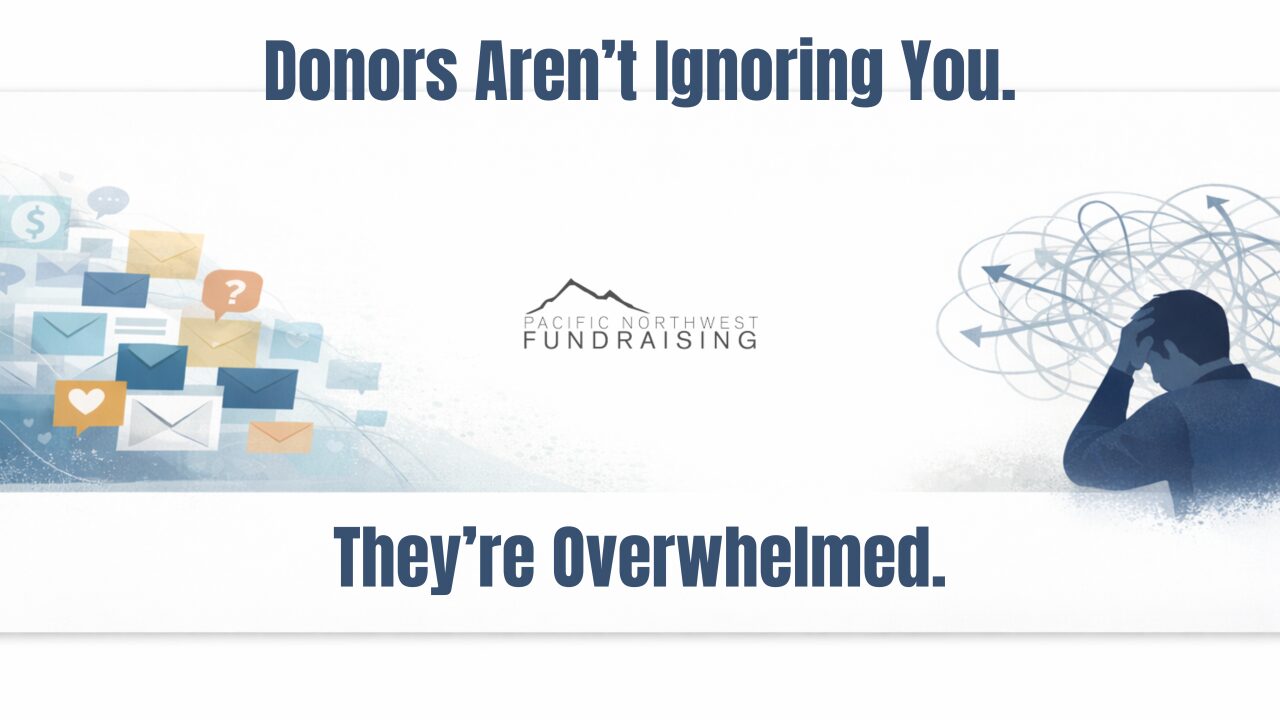
One of the things I remember from my early marketing classes is that it takes multiple touches before someone acts on a call to action. Depending on the study, it’s somewhere between 7 and 27 views before a person clicks, gives, or says yes.
That’s not a failure of messaging. That’s just how humans work.
And yet, many nonprofits still treat each campaign like it’s the only moment a donor will ever see them.
So they throw the kitchen sink at it.
Multiple programs. Multiple asks. Multiple ways to give. Multiple messages, all at once.
And then we’re surprised when donors… don’t act.
The Jam Problem (Yes, the Jam Study)
There’s a well-known behavioral economics study — often called the raspberry jam study– that found people were less likely to make a purchase when presented with too many choices.
When shoppers were offered 24 types of jam, fewer people bought. When they were offered 6, sales increased dramatically.
More options didn’t create more engagement. They created decision paralysis.
Donors are no different.
When a campaign asks them to:
- Support five programs
- Choose between monthly, one-time, event-based, and peer-to-peer giving
- Read a long explanation of everything the organization does
…the brain doesn’t say “wow, impressive.”
It says, “I’ll come back to this later.”
And later rarely comes.
Attention Is Scarce. Clarity Is Kind.
We’re living in a moment where attention spans are shrinking, not because people care less, but because everything is competing for their focus.
In that environment, clarity beats volume every time.
Donors don’t need more information. They need repetition of a simple, trustworthy message over time.
That’s why “organizational touches” matter:
- A consistent message
- A clear role for the donor
- A single, understandable ask
Not louder fundraising. Not more options. Just better stewardship.
This Is Why Development Is a Team Sport
Effective fundraising doesn’t come from one heroic campaign or one perfect email.
It comes from:
- Disciplined messaging
- Consistent stewardship
- Systems that support follow-up instead of urgency
This is also why expecting one person — often a Development Director — to manage strategy, messaging, data, campaigns, major gifts, grants, and stewardship is unrealistic.
Those are different jobs.
And when they collapse into one role, the result is usually more noise, not more clarity.
A Simple Reframe
If donors aren’t responding, the answer usually isn’t:
“We need to say more.”
It’s:
“We need to say less — more consistently.”
When nonprofits slow down, simplify, and respect how donors actually make decisions, giving becomes easier. Trust builds. Momentum follows.
And ironically, fundraising starts to feel less frantic… and more human.
This is something we think about a lot at Pacific Northwest Fundraising — not because nonprofits aren’t working hard, but because they’re often working against human behavior instead of with it.
If you have questions, reach us through 📧 outreach@pacificnorthwestfundraising.us
🗓️ Schedule time: https://meetings.hubspot.com/eddie94